Induction Hardening Process
April 7th, 2021
Induction hardening is the heating process that increases the hardness and tensile strength of ferrous materials. Induction tempering increases the toughness of iron-based alloys. Tempering reduces some of the excess hardness.
The IPEC team’s objective with the client is to harden and temper plates while maintaining flatness without warping the plate. The team conducted lab tests in addition to utilizing formulas. They decided to initially approach the project with all parts stationary using a large oval-shaped coil. Radyne’s coil department custom-made a cage coil to heat treat the entire plate in order to reach transformative heat temperatures of 1600°F. In order to do this, our team used a 150kW TFD with a pyrometer. Initial results reached the desired temperature but the team saw distortion within the plate.
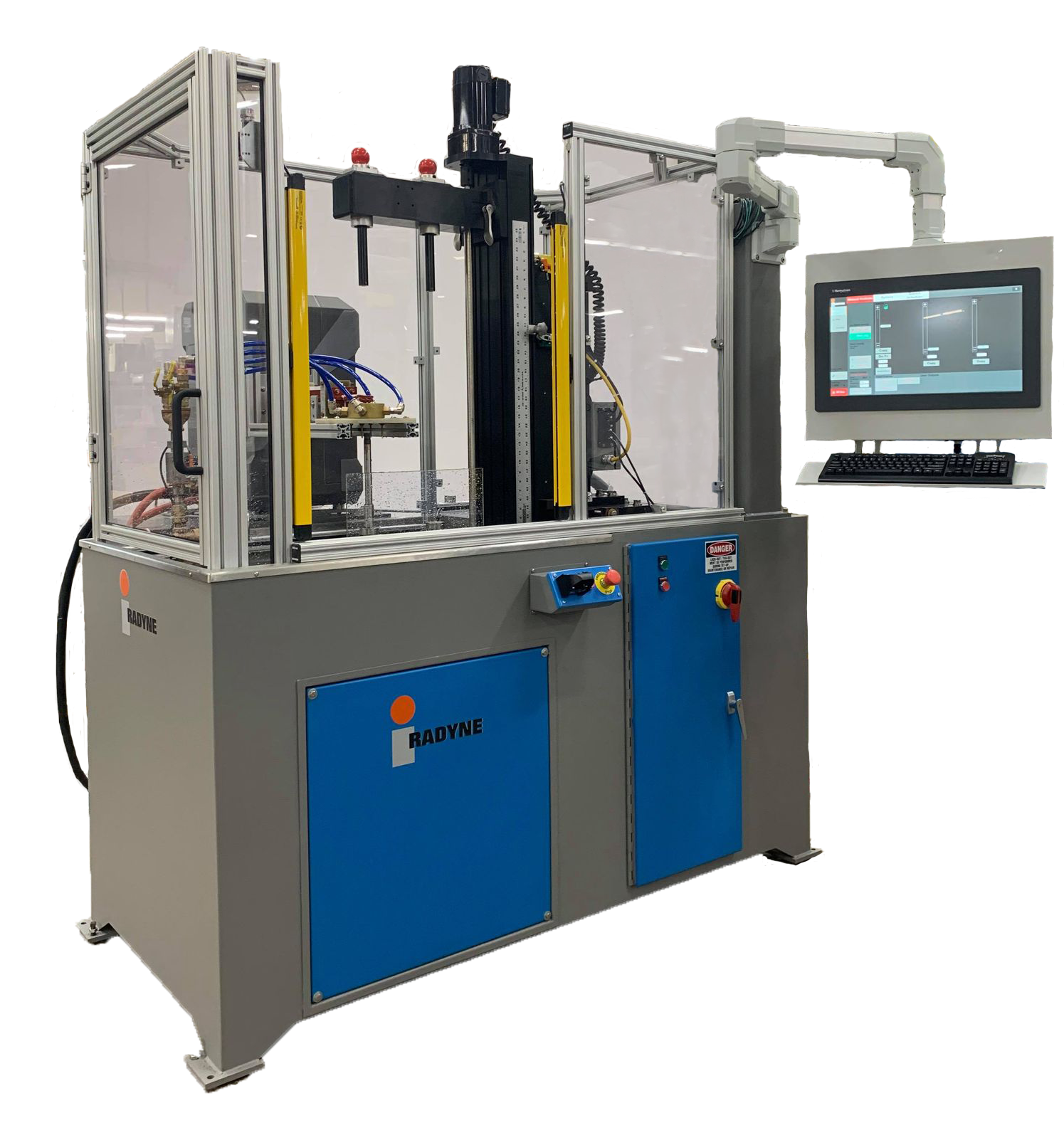
The next iteration of figuring out a process had everyone shift from statically heating the part to scanning the part. It shifted from TFD cage coil to hardening and tempering using an induction ScanMaster with Motus controls and quench base. In addition, the coil changed to a two turn oval coil. The two turn coil wasn’t reaching ideal power output, so the team switched to using a one turn coil instead. With the new coil, were able to reach ideal heat evenly across the steel plate, but learned there are uneven hardness on the surface. The reasoning behind this is the way the quench was hitting the part after being scanned through the coil. The best way to reach an even harden, is setting up a more evenly distributed quench rig and quench flow/pressure.
After a few iterations of hardening and tempering with an induction scanner, we are meeting specifications with the new quench set up. When measuring hardness, we cut the part in half and look how deep the hardness reached on both sides of the part using equipment in our IPEC lab.
Recent Posts

Induction Carbide Brazing
Successful Carbide Brazing with Induction Brazing is a successful and …Read More »
Aluminum Induction Brazing Advantages
Before we discuss the advantages of induction brazing of aluminum …Read More »
The Steps for Brazing Success
What are the steps to ensure a good braze joint? …Read More »
Induction Brazing Success
Induction brazing can solve many problems caused by a flame torch …Read More »
What Are The Advantages of Induction Brazing?
Induction brazing has many advantages over the other common heating …Read More »