Stress Relieving For Welding
What is Stress Relief in Induction?
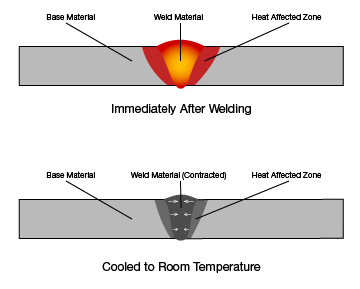
Stress relieving is a post-weld treatment that reduces residual stresses present in a workpiece after welding. These residual stresses could cause distortion or premature failure of the joint if left untreated. The stress relieving process involves heating the workpiece or localized area around a weld to a specific temperature. It holds at that temperature for enough time to reduce the stresses present in the material. It then cools the material at a slow enough rate so as to not allow the stresses to redevelop. Another way to think of this process is that you are essentially annealing the welded area.
Stress relieving can also use a pre-heat method prior to welding. This ensures that both welded surfaces are at the same temperature. Starting the parts at a higher temperature reduces the difference between the welded and non-welded areas, creating less tension.
Stress relieving is important because internal stresses in the weld can result in a weaker joint that may lead to premature failure.
Precise heat control means stress relieving the welded area of a part doesn’t affect the rest of the part. In some cases, induction technology integrates right into the same machines or part fixturing used for the welding which can save significant time and energy when dealing with large parts.
Advantages of Stress Relieving
| Advantage | How Induction Weld Stress Relieving Helps |
| Precise Temperature Control | Induction heating provides accurate control over heating temperatures, ramp rates, soak times, and cooling cycles for repeatable stress-relieving results. |
| Localized Heating | Heat can be concentrated around the weld and heat-affected zone (HAZ), reducing unnecessary heating of the surrounding component. |
| Reduced Residual Stress | Controlled heating helps relieve residual stresses created during welding, improving the stability and performance of the welded component. |
| Reduced Risk of Distortion | Applying controlled, localized heat can minimize thermal gradients and help reduce unwanted dimensional changes during stress relieving. |
| Rapid Heating | Induction delivers heat directly to the workpiece, allowing components to reach the required stress-relieving temperature quickly and efficiently. |
| Uniform Heating | Properly designed induction coils and process parameters can provide consistent heating around the weld area for more uniform treatment. |
| Improved Energy Efficiency | Energy is concentrated in the area requiring heat treatment rather than heating an entire furnace or large surrounding area. |
| Consistent & Repeatable Results | Programmable temperature and time parameters make induction stress relieving highly repeatable across multiple welds and components. |
| Improved Process Control | Automated monitoring and temperature-control capabilities allow manufacturers to closely manage the complete heating and cooling cycle. |
| Reduced Processing Time | Rapid heat-up and targeted heating can shorten overall stress-relieving cycles and improve manufacturing throughput. |
| Clean, Flame-Free Heating | Induction generates heat electromagnetically within the workpiece without direct flame contact, creating a cleaner and more controlled heating process. |
| Flexible for Different Applications | Induction stress relieving can be adapted to a variety of weld configurations, component sizes, materials, and production requirements. |