Induction Brazing
Brazing with Induction
Induction technology has proven to be valuable in the brazing process for many reasons. Firstly, rapid heading and precise heat control allow localized heating of components without significantly changing the material properties. Also, It allows for the brazing of materials such as aluminum and sequential, multi-alloy brazing, and soldering of close proximity joints.
Induction brazing is versatile and adaptable to unique production lines. As a result of our modular design philosophy, our equipment allows for the strategic arrangement of your facility. Induction brazing equipment simplifies the process of part fixturing which frees up operators’ hands and increases equipment lifespan.
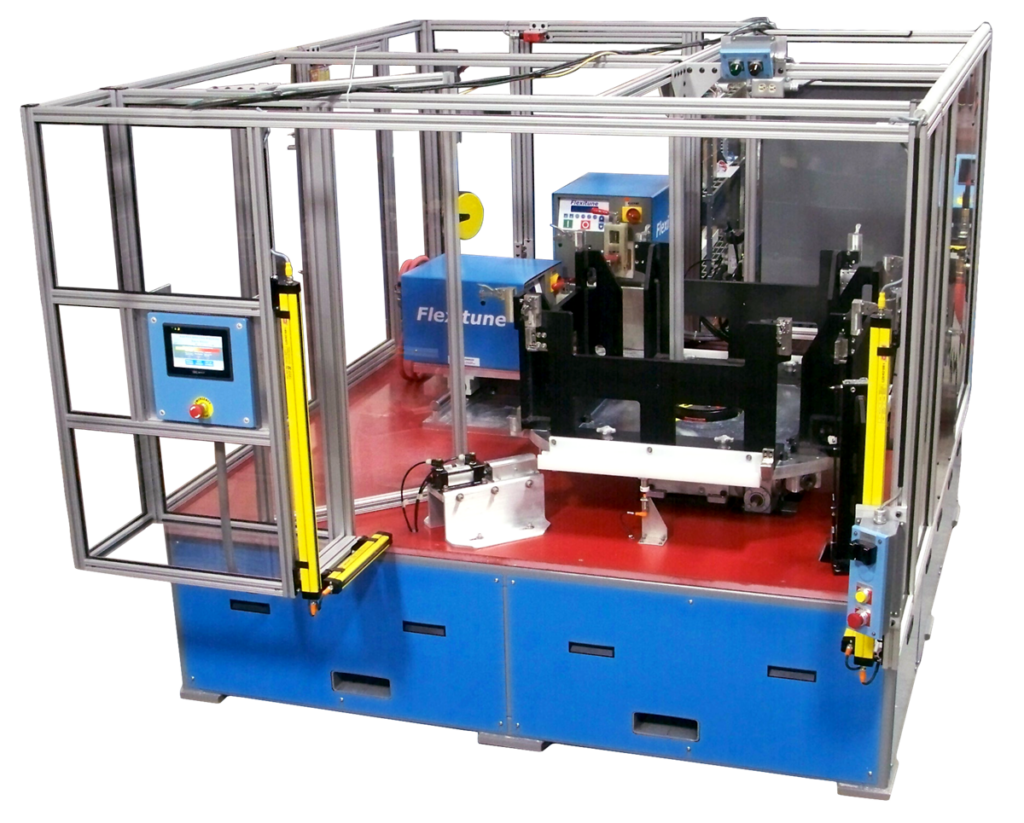
Radyne offers a full line of cutting-edge Induction Brazing Equipment ready to integrate into your production line. Radyne Induction brazing systems eliminate flame from your production facility which reduces costs, creates a higher-quality braze joint, and improves safety. The systems configure for manual control or pre-programmed recipes. As a result, this increases repeatability and reduces operator training requirements. Radyne Induction brazing and soldering systems repeatedly provide clean, leak-free joints for a wide range of parts including fuel lines, heat exchangers, gas distributors, manifolds, carbide tooling, and more (See What is Brazing and Soldering).
Controlled Atmosphere Induction Brazing Systems
Induction brazing can join components in special environments. Reducing atmospheres or vacuums produces brazed assemblies that rely on controlled atmospheres to prevent the formation of oxides during heating. Radyne is able to option controlled atmosphere chambers for almost all of our brazing equipment.
| Advantage | How Induction Brazing Helps |
| Precise Temperature Control | Induction heating provides accurate control over temperature, power, and heating time, helping achieve consistent brazed joints while reducing the risk of overheating. |
| Localized Heating | Heat can be concentrated directly at the joint area, minimizing unnecessary heating of surrounding components and materials. |
| Fast Heating Cycles | Induction rapidly brings the joint to brazing temperature, reducing cycle times and increasing production throughput. |
| Consistent & Repeatable Joints | Programmable process parameters help produce uniform heating cycles and repeatable braze quality from part to part. |
| Strong, Reliable Joints | Controlled heating promotes proper filler-metal flow and bonding, helping create durable joints that meet demanding application requirements. |
| Reduced Part Distortion | Targeted heating limits the amount of the component exposed to elevated temperatures, helping minimize thermal distortion. |
| Improved Energy Efficiency | Energy is concentrated in the workpiece and brazing area rather than heating a large furnace or surrounding environment. |
| Easy Process Automation | Induction brazing can be integrated with automated part handling, temperature monitoring, process controls, and production lines. |
| Clean, Flame-Free Heating | Induction generates heat electromagnetically without direct flame contact, providing a clean and controlled brazing process. |
| Reduced Operator Variability | Automated and programmable heating cycles reduce dependence on operator technique, improving process consistency. |
| Suitable for Complex Assemblies | Induction coil designs can be tailored to different joint configurations, part geometries, and production requirements. |
| Compatible with Many Metals | Induction brazing can be used to join many ferrous and non-ferrous metals, including steel, stainless steel, copper, brass, and aluminum when appropriate brazing processes and filler metals are used. |