Shrink Fitting With Induction
What is Shrink Fitting?
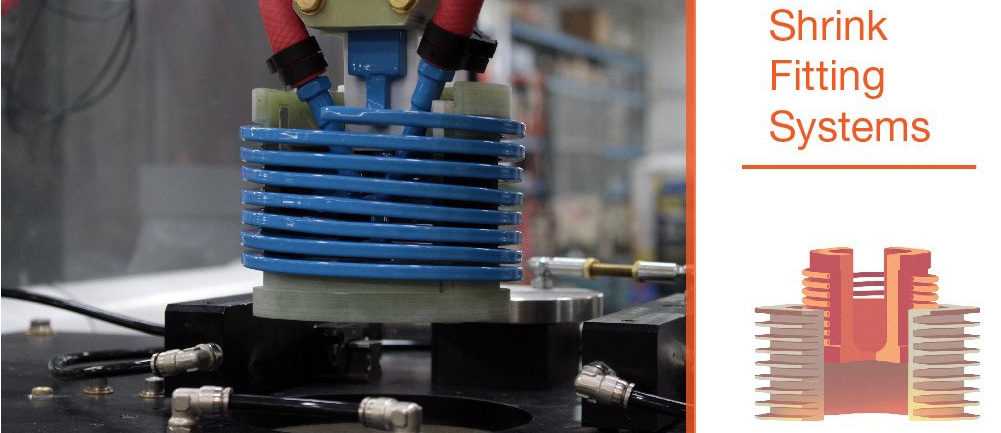
Shrink fitting is a very simple process that takes advantage of the tendency of materials to expand when heated. Usually, this process involves inserting a room temperature component into another component that has been heated. The room temperature component is able to be inserted with relative ease because the heat has caused the mating surface of the second component to expand slightly. After insertion, the components are allowed time to cool. This cooling causes the mating surface to contract around the first component and form a non-permanent mechanical bond.
Each method of securing parts in an assembly has unique advantages. In the case of shrink fitting, parts made from any metal can be assembled: steel to steel, steel to copper, aluminum to steel, magnesium to steel, etc. This is done at a relatively low temperature which mitigates changes in the metallurgical structure and avoids oxidation. No cleaning is required after assembly because of this. Shrink fitting is also able to be reversed easily and without damaging the components by selectively heating the outer component causing it to expand again.
Advantages of Shrink Fitting
Induction heating technology lends itself well to shrink fitting because it offers precise control and rapid heating times. Heat can be focused locally so as to only affect the area immediately around the matting surface. This saves energy with large components because the entire part does not need to be heated. It also helps prevent distortion and cracking caused by repeated heating and cooling making induction ideal for components requiring frequent disassembly and reassembly. Rapid heating times mean that production efficiency can be maximized. Induction processes produce a repeatable and consistent result which makes it easy to incorporate automation.
Want to learn more about shrink fitting components with induction heating? Contact Radyne Corporation today to speak to one of our experts.
Learn more about the Inductotherm Group.
Advantages of Shrink Fitting
| Advantage | How Induction Shrink Fitting Helps |
| Precise Temperature Control | Induction heating provides accurate control over temperature, power, and heating time, allowing components to expand predictably for proper assembly. |
| Fast Heating Cycles | Induction rapidly heats the targeted component, reducing assembly time and supporting higher production throughput. |
| Localized Heating | Heat can be concentrated on the component that needs to expand while minimizing unnecessary heating of surrounding parts and assemblies. |
| Consistent & Repeatable Results | Programmable heating parameters help ensure components reach consistent temperatures and expansion levels from cycle to cycle. |
| Strong Interference Fits | Once the heated component cools and contracts, it creates a secure mechanical interference fit without requiring additional fasteners or joining materials. |
| Reduced Risk of Part Damage | Controlled thermal expansion can reduce the need for excessive mechanical force during assembly, helping prevent damage to precision components. |
| Improved Energy Efficiency | Energy is concentrated directly in the area requiring heat instead of heating an entire furnace or surrounding environment. |
| Easy Process Automation | Induction shrink fitting can be integrated with automated material handling, temperature monitoring, assembly equipment, and process controls. |
| Reduced Operator Variability | Programmable heating cycles provide greater process consistency and reduce dependence on manual heating techniques. |
| Clean, Flame-Free Heating | Induction generates heat electromagnetically without direct flame contact, providing a clean and controlled heating process. |
| Improved Production Efficiency | Rapid, repeatable heating can shorten assembly cycles and make induction shrink fitting well suited for high-volume manufacturing. |
| Flexible for Different Components | Induction systems and coils can be designed for a variety of component sizes, geometries, materials, and interference-fit applications. |